

In this newsletter:
What is the enneagram
How to be ‘tri-lingual’
Passions, Fixations, Vice, Virtues oh my!
Instincts and subtypes
Quick reference for all 9 types
WHAT IS THE ENNEAGRAM?
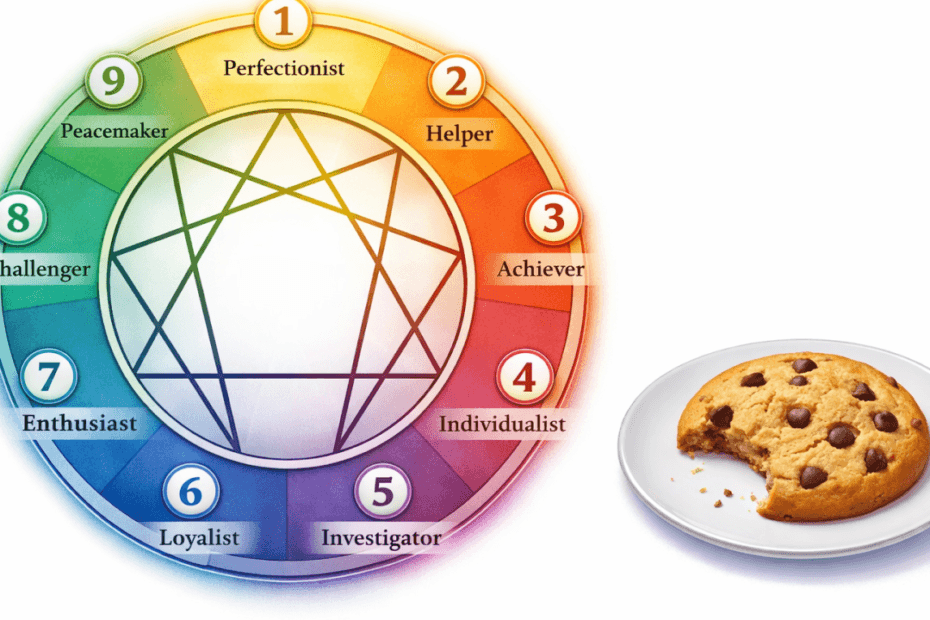
The enneagram is a typology-based system describing 9 unique personality types. Each of these 9 types is driven by unique motivations which affect our habitual unconscious thinking, feeling, and behaviour, as well as what we don’t notice or pay attention to. From an enneagram perspective, our personality type is a false self- a way of coping and compensating so that our needs are met. Our type dictates how we show up when we are not conscious.
3 Wisdom Centres
The 9 types are grouped into 3 wisdom centres- head (types 5, 6, 7), heart (2, 3, 4), and body (8, 9, 1). The enneagram system sees the human as having 3 wisdom centres that represent three unique ways of perceiving and responding to the world. Among the many ways of focusing our development, we can build a ‘tri-lingual’ capacity of learning what the head, heart, and body are telling us in any given situation.

The body tells us what our intuition or gut instinct is saying.
Try- flip a coin in a situation you aren’t sure and identify two distinct outcomes. Immediately upon the head or tail outcome, focus immediately on your body’s reaction. Tightening, butterflies etc. This is your body’s communication.

The head tells us what we think, believe or mentally process in a situation. This centre (regardless of type) is often the most available.
Try– write out the concrete, observable steps of a situation without emotion. Strictly facts. Your head can bring (when grounded and not in spiralling thoughts) objective clarity.

The heart tells us how we feel about a situation and others.
Try– put your hand on your physical heart space, allow your breath to soften and feel yourself slow down into calm. Ask your heart ‘what are you feeling?’ You may support yourself in this heart language by using a feelings wheel (available by searching ‘feelings wheel’) to add to your emotional vocabulary.

Coaching Suggestion to Build Tri-lingual Fluency
When you are pondering a decision, pause and use the above suggestions to ask your head, heart, and body about ‘their’ perspective.
9 Unique Passions and Fixations

What are the Passions?
Each type has a passion associated with it. The passion is the central emotional-motivational driver for each type. The passions are emotional and unconsciously drive us towards meeting basic needs. By understanding our type-based motivation we can start to witness how it shapes everything. In our journey of waking up, it’s critical to start to see how this passion/motivation drives our attention, behaviour, preferences, relationships and more. As we start to notice the passion’s influence, we appreciate how narrow its efforts are.

What are the Fixations?
The fixation is based in our thinking realm. It is a habitual limited way of thinking which limits our beliefs, feelings, and actions.
9 Unique Vices and Virtues
What are the Vices?
The Vices is another name for the Passions. They are the ego’s effort at trying to reclaim that which was lost (as represented by the Virtue). The Vice is the emotion’s motivation (see above under Passions).
What are the Virtues?
The Virtues represent our true selves. They are our actualization as our Vice is converted into its true self. During our growth journey, we can make a vice to virtue conversion so that we are living from our true self, manifesting our higher capacities.
To be clear, living from this place requires concerted effort, grit, time, community, and grind. That effort is different for each type.
3 Instincts
My enneagram lineage is through Beatrice Chestnut and Uranio Paes. These teachers were deeply informed by the modern pioneers of enneagram, notably Gurdjieff, Ichazo, and Naranjo. Chestnut and Paes’ teachings include the 3 instincts, which when combined with the 9 enneagram types give us 27 ‘subtypes’.

What are the Instincts?
Instincts are our primal orientation to survival. We don’t think about our instincts; they just show up when we feel we’re under threat. Boom! I pay attention to ‘this’.
- Self-Preservation Instinct– focuses attention on personal safety and security. Am I ok? Attention can be directed to material (food, clothing, shelter), and personal well-being however that is personally defined. Behaviour is shaped by this attention.
- Social Instinct- focuses attention on belonging, relationships, hierarchy, community. This attention asks are we all (defined by the person) ok? Behaviour is shaped by this attention.
- Sexual or One-to-One Instinct- focuses attention on the quality of significant relationships as defined by the person. This attention asks are my closest people and me ok? This instinct creates a more intense energy towards people and priorities. Energy focuses more towards significant individuals and shapes behaviour accordingly.
We all have all three instincts. However, we each have a primary instinct- the one that just shows up, no thought. It is an instinctual drive to survive. And many times it is overused and not necessary for that situation. For example, in a conflictual team meeting, your primary instinct may get triggered and you react from the belief you need to survive. It is misaligned to the actual situation- you won’t die in this meeting. Growth work can focus on seeing how the instinct alone manifests and you can build capacity to loosen its grip.
Subtypes
This is one of the most powerful modern additions to enneagram work more fully defined by Beatrice Chestnut and Uranio Paes.
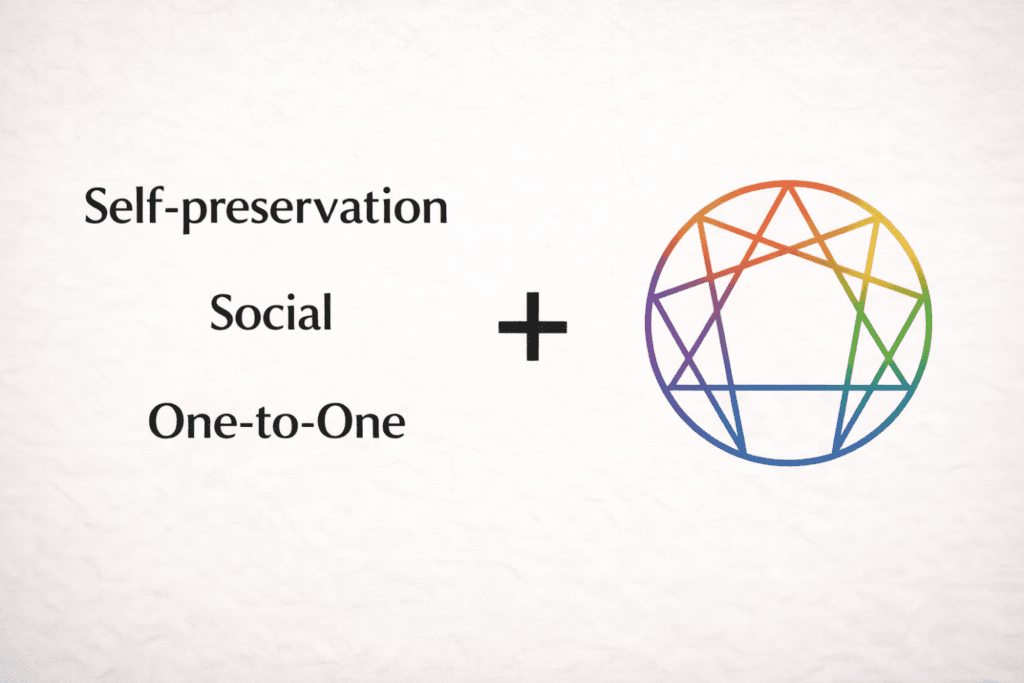
Subtypes are the combination of the survival drive of the instinct + the passion of the type. That means there are 27 subtypes.
By learning the subtypes we really begin to see why not all Sevens, for example, look the same. We start to see how the instinct influences the motivation of the type. More to come in future Enneabites.

How We Grow and Loosen the Grip of our Type
Among the many powerful aspects of the enneagram is that it doesn’t just tell us our type, the enneagram also provides evolutionary and revolutionary pathways of growth, of consciousness, and waking up to our true selves. The path of waking up requires motivation, commitment, humility, and compassion. In future Enneabites I’ll dive into these pathways. Suffice to say, it’s one of the ways the Enneagram is uniquely powerful in the land of personality.
Each type has a unique passion (emotion) and fixation (pattern of thinking) that is unconscious. In future Enneabites I’ll explore this more but for this primer, the enneagram shows us specific pathways for each type that result in us becoming more conscious.
Each type has two wings (the numbers on each side of our type). We typically have more access to at least one of these types.
Coaching Suggestion- learn more about the strengths of one of your wings. For example, I’m a Type One. I can build some peacekeeping muscles from my Nine-wing when I’m in meetings.
Wing work is evolutionary. It is a great step towards our growth. To learn more about this, have a read of “The Enneagram Guide to Waking Up” by Beatrice Chestnut and Uranio Paes.
Revolutionary work is using the two unique lines associated with each type. The two types associated with our revolutionary work are designed to shake us out of unconsciousness. For example, as a Type One, I have a line to Type Seven. In my more serious nature as a One, the Seven invites me towards spontaneity and play.
The line-work is where the rubber hits the road- it is hard work and needs to be done with a community or a professional knowledgeable in enneagram. We can’t see past ourselves so we need others when doing this part of the work.
WHY CHOOSE THE ENNEAGRAM?
Hopefully this primer provides some idea of the power of the enneagram. It provides a pathway of awakening based in a profound wisdom and belief that we all have a spark of awakening and consciousness within. In so doing we show up whole and collectively we contribute to greater peace.
QUICK REFERENCE
For each type:
- Motivation
- Vice/Passion
- Fixation
- Virtue
8
To be in control, strong
Lust- passion for excess, seek intensity
Vengeance- being aware of injustices, and seek revenge through intimidation or anger
Innocence- no need for power, have a pure heart, connecting to flow
9
To keep balance and harmony
Laziness, Sloth- keep asleep to self
Indolence- habit of not thinking about or caring about your own priorities & needs
Right Action- being awake & fully present. Know own needs, wishes
1
To do the right/good thing
Anger- low level resentment for things not being as they should or could
Resentment- things are imperfect and I need to fix them & no one else tries
Serenity- free of a ‘right’ way, can go with a flow
2
To be liked and appreciated
Pride- inflation and deflation cycle based on fulfilling others’ needs
Flattery- being what others want them to be so they will be admired and attractive
Humility- I am worthy and good enough as I am
3
To be the best
Self-deceit- shape shift to present self in a positive, admirable light
Vanity- need to sustain a good image, live through the eyes of others
Veracity; Hope- becoming aware of shape shifting, and being okay without pushing things forward
4
To be unique and authentic
Envy-sense of lack & craving for what is perceived to be lacking, missing
Melancholy- something is missing, nostalgia for past, future is ideal
Equanimity- being ok with the ups and downs without focusing on either. Emotions are at a healthy distance.
5
To understand
Avarice- not having enough and holding on to what they have
Stinginess- there is no abundance, or external support. Reluctant to share self and knowledge.
Non-attachment- experiencing a deeper flow of life. Letting go of clinging to ideas etc
6
To be safe and belong
Fear- can take many forms- unknown, perceived threats etc
Cowardice- doubt, question, procrastination, analysis paralysis
Courage- awake of dangers and able to address with confidence
7
To experience it all, avoid pain
Gluttony- desire to experience pleasurable things and a variety
Anticipation; planning- keep mood up, have options, stay optimistic
Sobriety- appreciate the present, seeing things through, can be happy enough
*I’m indebted to my teachers Beatrice Chestnut and Uranio Paes for their deep and abiding commitment to supporting growth, awakening and transformation